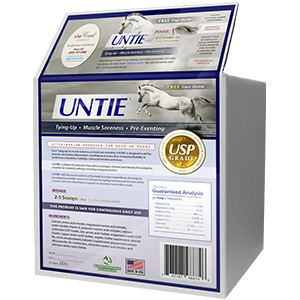


This FAQ is written for veterinarians and equine health professionals seeking concise, clinically framed answers regarding the appropriate use of Untie® as a nutritional support product. The intent is to address common professional questions while preserving diagnostic clarity and evidence-aligned decision-making.
No. Untie® is not a treatment, cure, or medication for tying up or exertional rhabdomyolysis (ER).
Untie® is a nutritional support product used to support normal muscle function and recovery as part of a veterinarian-directed management program. It does not replace diagnosis, medical treatment, or disease-specific management.
Additional context on how Untie® is used within broader equine management programs can be found here: Untie® support for performance horses.
Yes. Untie® may be used alongside NSAIDs when clinically appropriate.
Untie® does not act as an analgesic or anti-inflammatory drug and does not share mechanisms with NSAIDs. Because it does not mask pain or inflammation, it can be used without compromising clinical assessment.
Concurrent use should always be determined by the attending veterinarian.
No. Untie® does not interfere with diagnostic evaluation.
It does not often affect gait analysis, lameness examinations, serum muscle enzyme interpretation, or genetic testing. Because Untie® does not suppress pain or inflammation, diagnostic clarity is preserved.
Untie® is not a primary treatment for polysaccharide storage myopathy (PSSM).
Primary PSSM management remains dietary modification and consistent exercise. In select cases, veterinarians may elect to use Untie® as adjunct nutritional support within a broader management plan.
Untie® may be used as part of a long-term management strategy for horses with recurrent exertional rhabdomyolysis (RER).
It is typically integrated alongside training consistency, stress reduction, and dietary management. Untie® should not be relied upon as a stand-alone intervention.
Veterinarians recommend Untie® when additional muscle support is desired without pharmaceutical intervention.
Common use contexts include training transitions, increased workload, performance inconsistency without lameness, or a history of exertional muscle issues. Recommendations are based on risk management and workload demands, not diagnosis alone.
No. Untie® is not intended for acute episodes of muscle pain, cramping, or tying up.
Acute episodes require immediate exercise cessation and veterinary-directed medical care. Untie® is intended for preventive and supportive use, not emergency management.
From a veterinary perspective, Untie® is administered consistently on a daily basis.
Use is typically aligned with workload and training intensity, with periodic reassessment as management conditions change. Dosing should follow manufacturer guidance and veterinary discretion.
Yes. Untie® is formulated for long-term daily or situational us as a nutritional support product.
It is appropriate for extended training and competition periods when ongoing muscle support is desired under veterinary oversight.
No. Untie® does not replace proper diet formulation.
Forage quality, non-structural carbohydrate control, and balanced vitamin and mineral intake remain essential. Untie® is intended to complement, not replace, foundational nutrition.
Untie® differs from pharmaceuticals in that it supports physiologic function rather than suppressing symptoms.
It does not mask pain or inflammation, does not interfere with diagnostics, and is suitable for long-term use. This allows veterinarians to incorporate Untie® without compromising clinical oversight.
This FAQ is provided for veterinary education only. It is not intended to diagnose, treat, or prevent disease. All clinical decisions should be based on individual patient assessment and current standards of veterinary care.